
How to Choose a Phase Contrast Microscope: A Complete Buyer's Guide for Research, Clinical, and Cell Culture Applications
Jul 24th 2026
Phase contrast microscopy has become one of the most valuable imaging techniques in biology, microbiology, clinical laboratories, and cell culture research. Unlike traditional brightfield microscopes, phase contrast microscopes allow researchers to observe transparent, living specimens without staining them, making it easier to study cells and microorganisms in their natural state.
Whether you're equipping a research lab, teaching university students, or purchasing a microscope for clinical applications, selecting the right phase contrast microscope involves more than choosing a magnification range. Understanding your application, specimen type, and optical requirements will help ensure you invest in a system that delivers the performance you need.
This guide explains how phase contrast microscopy works, when it's the best choice, and what to look for when selecting a phase contrast microscope.
What Is a Phase Contrast Microscope?
A phase contrast microscope is a specialized optical microscope designed to increase the contrast of transparent or nearly transparent specimens without the need for dyes or stains.
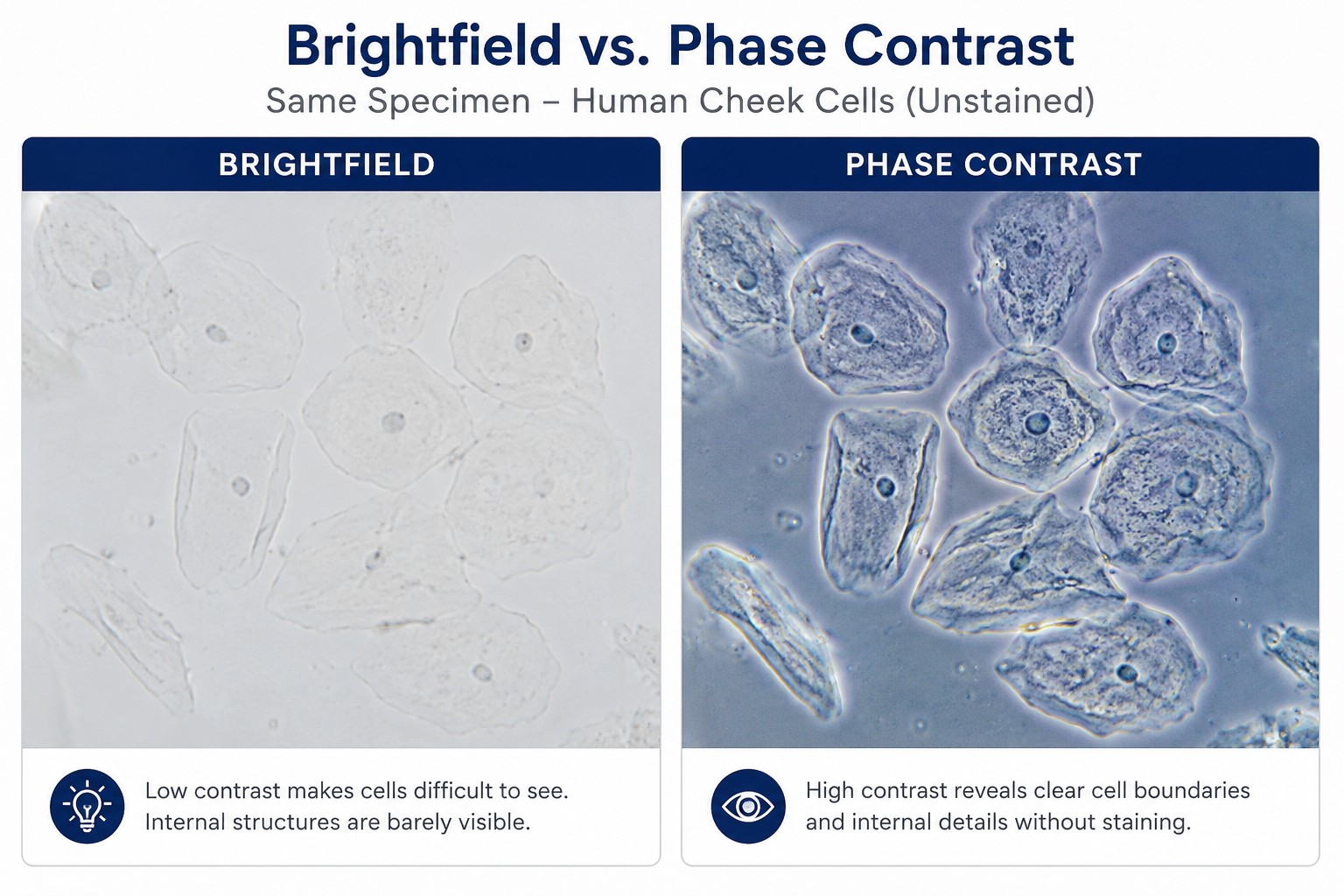
Many biological samples, including living cells, bacteria, yeast, and tissue cultures, allow light to pass through them with very little natural contrast. Under a standard brightfield microscope, these specimens can appear faint or nearly invisible. Phase contrast microscopy converts tiny differences in how light travels through the specimen into visible differences in brightness, producing clear, high-contrast images.
This makes phase contrast microscopy especially useful for observing living specimens that would otherwise be altered or damaged by chemical staining.
If your work involves routine observation of live cells, microorganisms, or unstained biological samples, a phase contrast microscope is often the preferred choice.
How Phase Contrast Microscopy Works
Although the technology behind phase contrast microscopy is sophisticated, the basic concept is surprisingly simple.
As light passes through a transparent specimen, different parts of the sample slow the light by varying amounts. These tiny changes, called phase shifts, are normally invisible to the human eye.
A phase contrast microscope uses specially designed objectives and a matching phase condenser to convert those invisible phase shifts into differences in light intensity. Instead of seeing a nearly transparent specimen, you see clear cellular structures with significantly improved contrast.
The result is a detailed image of living, unstained specimens that would otherwise appear difficult to distinguish using conventional brightfield microscopy.
When Should You Use Phase Contrast Instead of Brightfield?
Both brightfield and phase contrast microscopes have important roles in the laboratory. The right choice depends on the type of specimens you're examining.
|
Brightfield Microscopy |
Phase Contrast Microscopy |
|
Often requires staining |
Usually no staining required |
|
Best for stained tissue samples |
Best for transparent, living specimens |
|
Lower contrast for live cells |
Excellent contrast for unstained specimens |
|
Simpler optical system |
Specialized phase optics |
Phase contrast microscopy is especially beneficial for:
- Live cell cultures
- Yeast and fungi
- Protozoa
- Blood cells
- Bacteria
- Algae
- Tissue culture samples
- Fresh biological specimens
If your goal is to observe living cells over time or study cellular processes without altering the specimen, phase contrast microscopy offers a significant advantage over traditional brightfield imaging.
Phase Contrast vs. DIC Microscopy
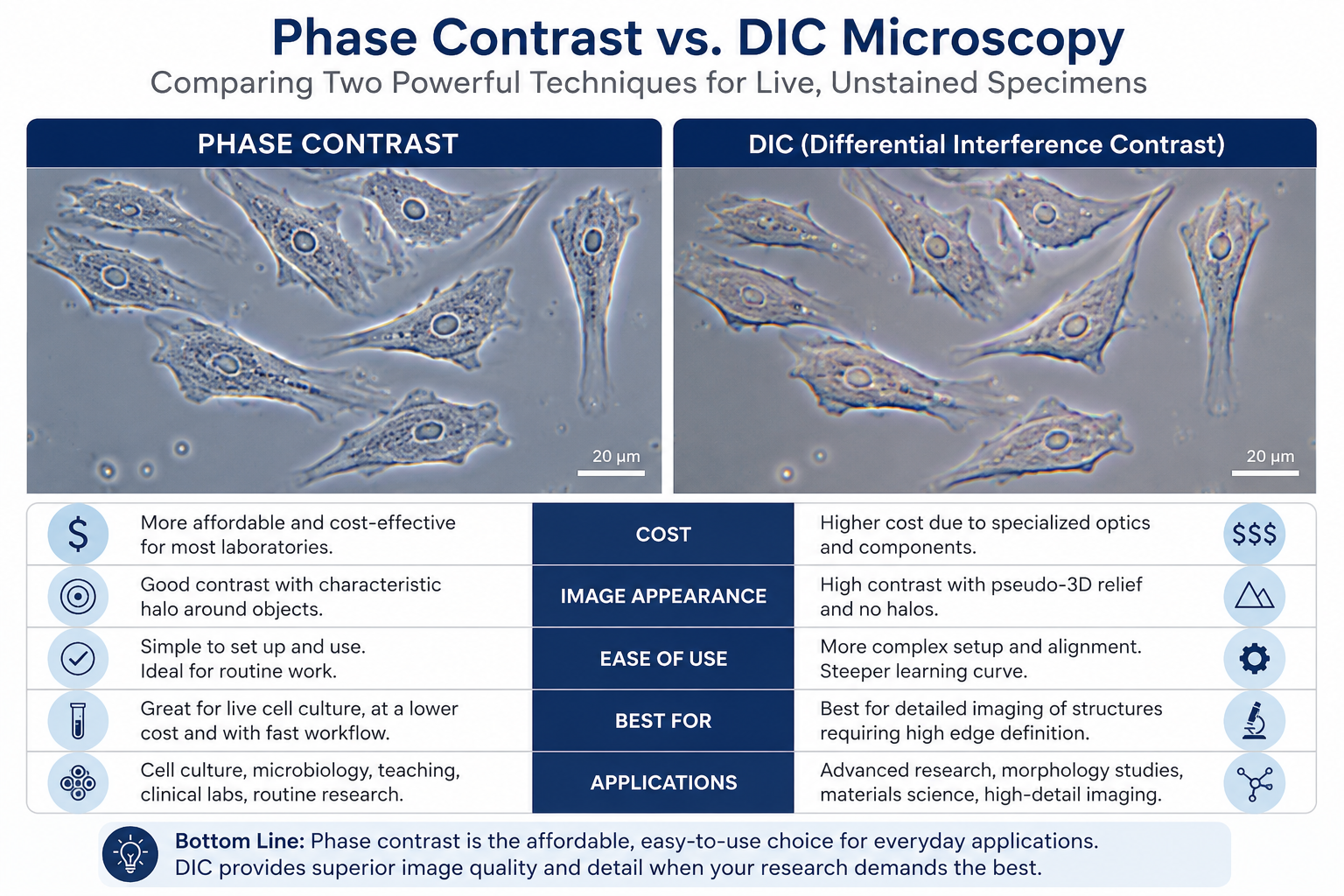
Phase contrast and Differential Interference Contrast (DIC) microscopy are both designed to improve the visibility of transparent specimens, but they serve slightly different purposes.
|
Phase Contrast |
DIC Microscopy |
|
Excellent for routine laboratory work |
Premium imaging technique |
|
More affordable systems |
Higher equipment cost |
|
Fast, easy operation |
More complex optical setup |
|
Halo artifacts may appear |
Superior edge definition and three-dimensional appearance |
For many research laboratories, teaching institutions, and clinical environments, phase contrast provides an excellent balance of image quality, ease of use, and affordability.
DIC microscopy is often preferred for advanced research applications where maximum image detail is required, but it also requires additional optical components and typically comes at a significantly higher cost.
Choosing the Right Phase Contrast Microscope for Your Application
The best phase contrast microscope depends on what you'll be observing. Rather than focusing solely on magnification, consider the type of work you'll perform most often.
|
Application |
Recommended Configuration |
|
Cell Culture |
Inverted phase contrast microscope |
|
Clinical Laboratory |
Compound phase contrast microscope |
|
Microbiology |
Compound microscope with phase objectives |
|
University Teaching |
Trinocular phase contrast microscope |
|
IVF & Embryology |
Inverted phase contrast system |
|
Research Laboratory |
Infinity optical system with camera compatibility |
When comparing systems, consider features such as:
- High-quality phase contrast objectives
- Infinity-corrected optics
- LED illumination for long-term reliability
- Trinocular viewing head for digital imaging
- Camera compatibility for documentation and analysis
- Mechanical stage for precise specimen positioning
- Expandability for future accessories
Choosing a microscope that can grow with your research needs often provides better long-term value than selecting the lowest-cost option.
Can You Upgrade an Existing Microscope to Phase Contrast?
In many cases, yes.
Some brightfield microscopes can be upgraded to phase contrast by adding compatible components, including:
- Phase contrast objectives
- A matching phase condenser
- Phase annuli
- Alignment telescope or centering accessories
However, not every microscope is designed to accept these upgrades. Compatibility depends on the microscope's optical system, objective design, and condenser configuration.
If you're considering upgrading an existing microscope, it's important to verify compatibility before purchasing additional components. In some situations, investing in a purpose-built phase contrast microscope may be the more practical and cost-effective solution.
Common Mistakes When Buying a Phase Contrast Microscope
Choosing the wrong microscope can lead to unnecessary costs or disappointing performance. Here are some of the most common mistakes buyers make:
Purchasing a Brightfield Microscope When Phase Contrast Is Needed
If you'll regularly examine transparent living specimens, a standard brightfield microscope may not provide enough contrast.
Choosing Incompatible Components
Phase contrast objectives and condensers must be designed to work together. Mixing incompatible components can reduce image quality.
Focusing Only on Magnification
Higher magnification does not always produce better images. Optical quality, objective design, and illumination are equally important.
Overlooking Camera Compatibility
If you'll be capturing images or sharing observations digitally, ensure your microscope supports camera integration.
Ignoring Future Expansion
Many laboratories eventually add digital cameras, fluorescence, or additional accessories. Choosing a microscope with upgrade potential can extend the life of your investment.
Why Choose Microscope World for Phase Contrast Microscopes?
Selecting a phase contrast microscope involves more than comparing specifications. The right optical configuration depends on your specimens, laboratory workflow, imaging requirements, and future research goals.
Microscope World offers a carefully selected range of phase contrast microscopes for research laboratories, universities, clinical facilities, and educational institutions. Whether you're purchasing your first phase contrast system or upgrading an existing laboratory, our microscope specialists can help you identify the best configuration for your application.
Browse our selection of Phase Contrast Microscopes to compare professional systems designed for cell culture, microbiology, clinical diagnostics, and advanced biological research.
Frequently Asked Questions About Phase Contrast Microscopes
Can phase contrast microscopes observe living cells?
Yes. Phase contrast microscopy was specifically developed to observe living, transparent specimens without requiring chemical stains.
Do phase contrast microscopes require staining?
No. One of the biggest advantages of phase contrast microscopy is that it provides excellent contrast without staining many biological specimens.
Can bacteria be seen with phase contrast microscopy?
Many bacteria can be observed using phase contrast microscopy, particularly when studying live organisms or monitoring movement. The visibility depends on the organism and magnification used.
What's the difference between phase contrast and darkfield microscopy?
Darkfield microscopy produces bright specimens against a dark background, while phase contrast improves internal contrast within transparent specimens. Each technique has different strengths depending on the sample being examined.
Can I convert my brightfield microscope to phase contrast?
Some microscopes can be upgraded with compatible phase contrast objectives and condensers. Others may require a dedicated phase contrast system.
Why do phase contrast images sometimes have bright halos?
Halo artifacts are a normal characteristic of phase contrast microscopy and result from the way the optical system converts phase differences into visible contrast.
Is an inverted microscope required for cell culture?
For most cell culture applications, an inverted phase contrast microscope is the preferred choice because cells are typically grown in culture flasks or dishes that are viewed from below.
What magnification is best for phase contrast microscopy?
The ideal magnification depends on the specimen. Many laboratories routinely use 10x, 20x, 40x, and 100x phase contrast objectives depending on the application.


