
Pollen Under a Microscope: What Does It Look Like?
Oct 16th 2026
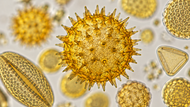
Pollen may look like ordinary yellow dust to the naked eye, but under a microscope, it reveals a surprising variety of shapes, textures, and intricate patterns. Some pollen grains are perfectly round, others are oval or triangular, and some even have tiny spikes covering their surfaces.
Under a microscope, pollen grains typically appear as small, round, oval, or irregularly shaped structures with textured outer walls. Depending on the plant species, these surfaces may be smooth, ridged, spiny, or covered in net-like patterns.
Examining pollen under a microscope provides a fascinating look at plant reproduction and helps scientists identify different plant species.
What Does Pollen Look Like Under a Microscope?
Pollen grains are microscopic structures produced by seed-bearing plants. They carry the male reproductive cells needed for fertilization.
Most pollen grains measure approximately 10 to 100 micrometers, although some species produce grains outside this range. A micrometer is one-thousandth of a millimeter.
When viewed through a compound microscope, several features become visible:
- Shape: Pollen can be spherical, oval, elongated, or triangular.
- Surface texture: Some grains have smooth surfaces, while others feature spikes, ridges, or honeycomb-like patterns.
- Color: Pollen often appears yellow, golden, or nearly transparent, depending on the species, preparation, and lighting.
- Pores and grooves: Small openings or furrows in the outer wall play a role in pollen germination.
The outer wall, called the exine, is particularly interesting because its patterns can help scientists distinguish between different types of pollen.
Different Types of Pollen Under a Microscope
Not all pollen looks the same. The plant species determines the size, shape, and surface features of its pollen grains.
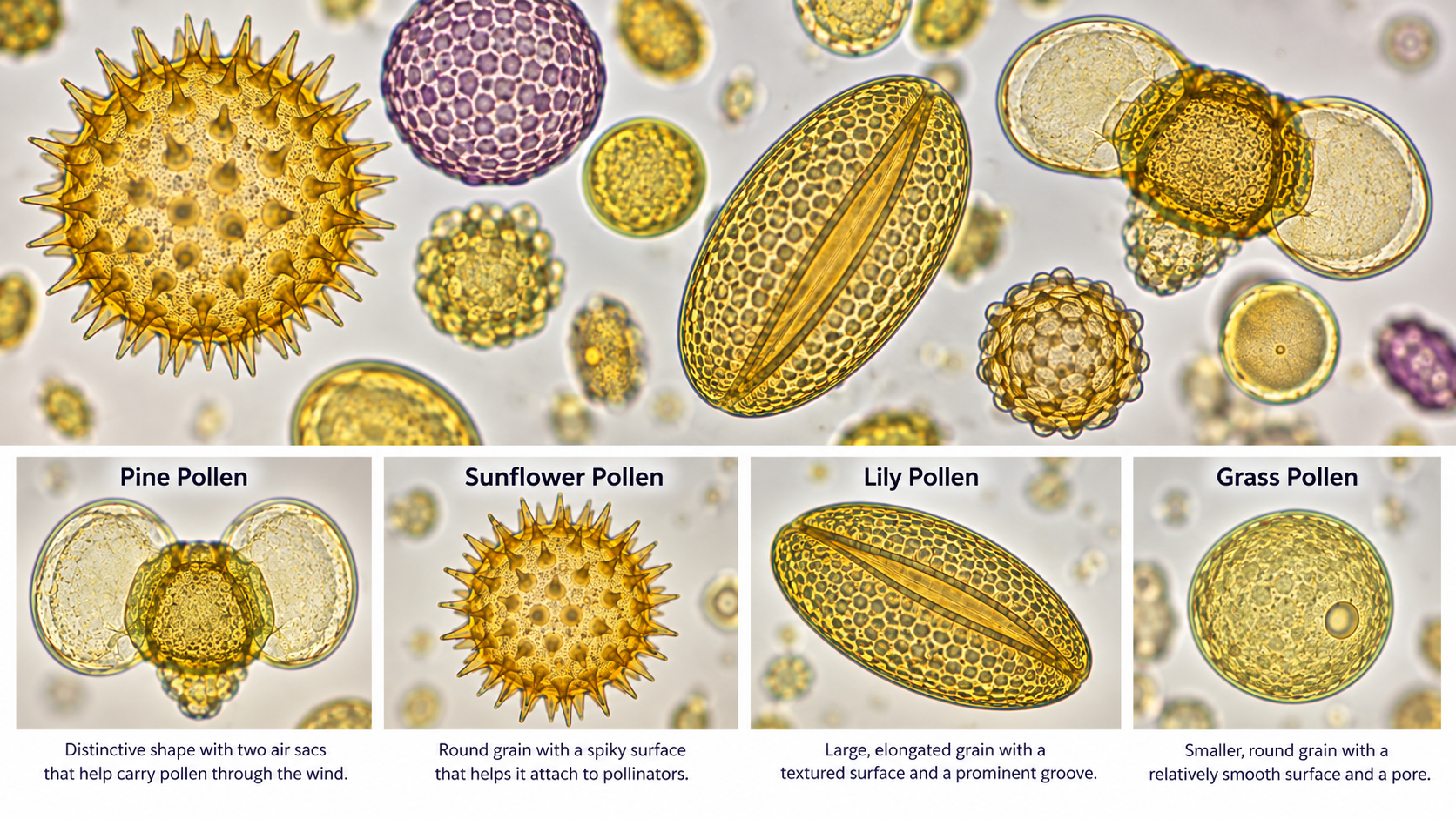
1. Pine Pollen Under a Microscope
Pine pollen has one of the most recognizable shapes. Each grain typically features a central body with two air sacs that give it a distinctive appearance resembling a pair of ears.
These air sacs influence how pine pollen travels through the air, allowing trees to distribute pollen over considerable distances.
What to look for: A rounded central body with two balloon-like structures on either side.
2. Sunflower Pollen Under a Microscope
Sunflower pollen is known for its spiky appearance. Under magnification, the grain resembles a tiny ball covered in pointed projections.
These structures are part of the pollen's outer wall and contribute to its textured surface.
What to look for: A spherical grain covered with numerous small spikes.
3. Lily Pollen Under a Microscope
Lily pollen grains are generally larger and more elongated than many other pollen types. Their oval or boat-like shape makes them relatively easy to recognize.
Under higher magnification, the outer surface may reveal a detailed network of ridges and a long groove.
What to look for: An elongated grain with a textured surface and a prominent groove.
4. Grass Pollen Under a Microscope
Grass pollen is generally smaller and more rounded than lily pollen. Many grass pollen grains have relatively smooth outer surfaces with a single distinctive pore.
Because grass pollen is commonly carried by the wind, it is also an important type of airborne pollen studied in allergy research.
What to look for: Small, nearly spherical grains with a relatively smooth surface and a pore.
What Magnification Do You Need to See Pollen?
You don't need an advanced laboratory microscope to observe pollen. A standard compound light microscope is usually sufficient.
|
Magnification |
What You Can See |
|
40x |
Small pollen grains appearing as tiny dots or specks |
|
100x |
Individual grains, basic shapes, and larger structures |
|
400x |
More detailed surface textures, pores, grooves, and spikes |
|
1000x |
Additional fine detail when the microscope's optical resolution supports it |
For most students and hobbyists, 100x to 400x magnification provides an excellent view of pollen grains.
A compound microscope with 10x and 40x objectives and a 10x eyepiece is well suited for examining pollen samples.
How to View Pollen Under a Microscope
Observing pollen is a simple microscopy activity that can be performed in a classroom or at home with the proper equipment.
Materials Needed
- Compound light microscope
- Glass microscope slide
- Coverslip
- Dropper with water
- Small brush or cotton swab
- Fresh flower containing visible pollen
Step-by-Step Instructions
- Collect the pollen. Gently brush the anther of a flower to collect a small amount of pollen.
- Prepare the slide. Transfer a tiny amount of pollen onto a clean microscope slide.
- Add water. Place a small drop of water onto the sample to help distribute the pollen grains.
- Apply the coverslip. Carefully lower a coverslip over the sample to reduce air bubbles.
- Start at low magnification. Begin at 40x to locate the pollen.
- Increase magnification. Switch to 100x and then 400x to examine the grains more closely.
Try collecting pollen from several different flowers and comparing their shapes and surface textures. Avoid inhaling loose pollen, particularly if you have pollen allergies.
Why Do Scientists Study Pollen Under a Microscope?
The microscopic structure of pollen provides useful information across several scientific fields.
Botany and plant identification: Scientists examine pollen morphology to help identify plant groups and study reproduction.
Environmental research: Pollen preserved in sediments can provide evidence about past vegetation and environmental conditions.
Allergy research: Identifying airborne pollen helps researchers monitor pollen-producing plants and investigate environmental allergens.
Forensic science: Pollen found on clothing, objects, or soil may provide clues about the environments those materials encountered.
The scientific study of pollen and spores is known as palynology.
Explore the Microscopic World of Pollen
Pollen is an excellent specimen for students, educators, and anyone interested in microscopy. Its remarkable variety of shapes and surface structures demonstrates how much detail exists in materials that appear ordinary to the naked eye.
With a compound microscope and a prepared slide, you can explore the microscopic features of pollen and discover how different plant species produce uniquely structured grains.
Whether you're conducting a classroom experiment or studying plant biology, Microscope World offers microscopes and microscopy equipment to help you explore the fascinating details of the natural world.
Frequently Asked Questions About Pollen Under a Microscope
Can you see pollen with a regular microscope?
Yes. Most pollen grains can be observed using a standard compound light microscope. Magnifications between 100x and 400x are particularly useful for examining their shapes and surface features.
What does pollen look like at 400x magnification?
At 400x, pollen grains may appear as rounded, oval, or elongated structures with visible ridges, spikes, pores, or grooves. Their exact appearance depends on the plant species and slide preparation.
Why do some pollen grains have spikes?
Spikes are part of the pollen grain's outer wall. In some insect-pollinated plants, these surface features can help pollen attach to pollinators. Surface structures also have other biological functions.
Is pollen a living cell?
Pollen grains are living reproductive structures containing cells that participate in plant fertilization. They are not simply particles of dust.
Can you identify a plant by its pollen?
Sometimes. Scientists use pollen size, shape, pores, and surface patterns to identify plant families, genera, and occasionally species. However, different plants can produce similar-looking pollen, so accurate identification may require specialized techniques.


